


What is striking throughout the survey is that organisations are not dealing with isolated issues. Instead, leaders are managing multiple interconnected pressures at once. Economic uncertainty, competitive intensity, workforce capability, technology adoption and changing stakeholder expectations are all converging simultaneously. This is creating an environment where leadership is becoming less about managing stability and more about operating effectively amid continuous disruption.
Leadership pressure is intensifying
The survey shows that organisations see economic uncertainty, talent acquisition and retention, digital transformation, operational resilience and competitive pressure as some of the most significant leadership challenges currently facing them.
Importantly, many respondents also indicated that these same challenges have become more problematic over the past year. This suggests that organisations are not simply experiencing ongoing disruption — they are feeling an escalation in both the pace and complexity of change.
For leaders, this creates a very different operating context. Traditional leadership approaches built around predictability, long planning cycles and incremental improvement are becoming harder to sustain. Organisations increasingly require leaders who can make decisions quickly, adapt strategy in real time and lead effectively through ambiguity.
The survey also points to a broader shift in leadership expectations. Leaders are now expected to manage operational performance while simultaneously driving transformation, maintaining culture, responding to workforce pressures and preparing organisations for future disruption. That balancing act is becoming increasingly difficult.
Readiness has not improved at the same pace as awareness
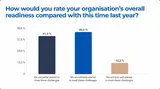
One of the more revealing findings is that while organisations are highly aware of the challenges they face, many do not necessarily feel significantly better prepared to address them compared with a year ago. Indeed over 60% of respondents indicated they were either less well or only similarly placed compared to 2025.
This points to a growing gap between awareness and execution.
In many organisations, leaders understand the nature of the disruption. They understand the importance of digital capability, workforce transformation and organisational agility. However, translating that understanding into meaningful organisational capability appears to be more difficult.
This is a common issue in periods of rapid disruption. Strategy development often moves faster than organisational capability building. Many organisations know what they need to do but struggle to operationalise change at the pace required.
As a result, leadership effectiveness is becoming increasingly tied not simply to strategic thinking, but to execution capability — the ability to align people, systems, culture and resources around sustained transformation.
Leadership talent remains a major constraint
The survey responses indicate demand for leadership capability has increased, yet almost a quarter of organisations report reduced success in attracting leadership talent.
This reflects broader global workforce trends. The leadership market has become more competitive, and expectations of leaders have expanded considerably. Organisations are no longer simply looking for technical or operational expertise. Increasingly, they are seeking leaders who can manage transformation, lead diverse teams, navigate uncertainty and integrate technology and people strategies simultaneously.
At the same time, according to the survey, even global organisations appear cautious about aggressively pursuing offshore leadership talent, with a significant proportion either preferring local candidates or not proactively sourcing internationally.
This may reflect concerns around cultural fit, labour market conditions or organisational familiarity. However, it may also unintentionally limit access to broader leadership capability at a time when talent shortages are intensifying.
The findings suggest that organisations may need to rethink traditional leadership pipelines and adopt more flexible approaches to leadership sourcing and development. Internal capability building, succession planning and broader talent market engagement are likely to become increasingly important over the coming years.
AI has moved from technology issue to leadership issue
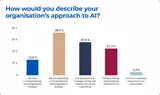
One of the clearest trends in the survey is the growing strategic importance of AI. Around two thirds of organisations report either having a developing AI strategy or responding to AI in a reactive way. Only a small proportion, or less than 15%, describe themselves as having a fully integrated AI strategy. This highlights the fact that while awareness of AI is widespread, organisational maturity remains uneven.
The barriers organisations identify are particularly telling. Challenges include insufficient internal capability, difficulty translating strategy into execution, cultural resistance and competing organisational priorities.
These are not primarily technology problems — they are leadership and organisational change problems.
The survey suggests that many organisations understand the strategic importance of AI but are still working out how to embed it operationally. This includes questions around governance, workforce capability, decision-making, risk management and organisational adoption.
Interestingly, around a third of surveyed organisations are relying on external consultants or advisors to support AI capability development, while about half are attempting to upskill existing employees. Reliance on external support may raise questions about long-term internal capability and organisational learning.
The organisations that are likely to succeed in AI implementation will not necessarily be those with the most advanced technology. Rather, they will be those able to integrate technology, culture, leadership and workforce capability into a coherent transformation strategy.
DEI remains important — but execution is uneven
The survey indicates that diversity, equity and inclusion continues to remain an important organisational priority. More than eight in 10 respondents reported maintaining or increasing their emphasis on DEI over the past 12 months.
Areas such as gender, race and ethnicity, and generational diversity appear to remain major focus areas for organisations.
However, the findings also suggest that many organisations are still struggling to consistently embed inclusion into leadership systems and accountability structures. While some organisations report holding leaders accountable for inclusive behaviours and outcomes, over a third describe inclusion as encouraged but not consistently measured, while others suggest it depends heavily on individual leaders.
This highlights an important distinction between commitment and operational integration.
Many organisations appear to have moved beyond seeing DEI as a standalone initiative. However, embedding inclusion consistently into organisational culture, leadership performance and decision-making remains a work in progress.
As with AI and broader transformation efforts, the issue is less about awareness and more about sustained execution and accountability.
The emerging leadership capability challenge
Taken together, the survey findings point to a broader leadership capability challenge emerging across organisations.
The issue is not that organisations are unaware of disruption or strategic priorities. In fact, most appear highly conscious of the pressures they face. The more significant challenge is whether organisations have the leadership depth, organisational capability and execution discipline required to respond effectively.
This is particularly evident in areas such as:
- AI implementation
- Workforce transformation
- Leadership attraction and retention
- Organisational agility
- Inclusion and culture
Across all of these areas, the same underlying theme emerges: execution capability is becoming the defining differentiator.
Organisations that can align leadership, culture, workforce capability and strategic execution are likely to be far better positioned than those relying primarily on reactive or fragmented responses.
Final reflection
What the survey ultimately reveals is that leadership itself is changing.
In a disrupted market, leadership is no longer simply about setting direction or managing performance within relatively stable environments. Increasingly, it is about helping organisations navigate uncertainty, absorb complexity and adapt continuously.
The most effective leaders are likely to be those who can balance short-term operational demands with long-term transformation, while also maintaining organisational trust, capability and resilience.
The data also suggests that many organisations are still in transition. Awareness of disruption is high. Recognition of the importance of AI, talent, agility and inclusion is widespread. Yet many organisations are still building the systems, culture and leadership capability required to fully respond.
Ultimately, the competitive advantage in the years ahead may not come from strategy alone. It is more likely to come from an organisation’s ability to execute consistently under pressure, adapt quickly to changing conditions and develop leadership capability that can operate effectively in complexity.
That is increasingly the defining leadership challenge of a disrupted market.